
What to Do After O Level in Zimbabwe in 2027: Courses, Skills and Career Opportunities
05 November 2026
Finishing Form 4 is an important milestone for students in Zimbabwe. After spending years preparing for Ordinary Level examinations, one big question usually follows:
“What should I do after O Level?”
For some students, the next step is Advanced Level. Others may consider professional courses, vocational training, apprenticeships or developing skills that could help them prepare for employment or entrepreneurship.
It is a decision that can feel overwhelming, especially when friends are choosing different paths and parents are considering the cost of further education.
But choosing your future should not simply be about following what everyone else is doing.
It should be about understanding your interests, recognising your strengths and exploring opportunities that match your goals.
If you are wondering what to do after O Level in Zimbabwe in 2027, this guide from WEPROE Africa Centre for Learning explores several educational and career pathways worth considering.
1. Understand Your Options After O Level in Zimbabwe
Completing Ordinary Level does not mean every student must follow exactly the same educational route.
Different careers require different qualifications, levels of training and practical experience.
Some professions require advanced academic qualifications. Others offer entry pathways through vocational education, professional training or apprenticeships.
Continue to Advanced Level
Advanced Level remains a suitable option for students who want to pursue academic subjects in greater depth.
It can be particularly relevant for those planning to apply for university programmes with specific A Level subject requirements.
Before choosing your subjects, research the entry requirements for careers or degree programmes that interest you.
Enrol in Professional Training
Professional training provides another pathway for students interested in developing knowledge and skills in a specific field.
Depending on the institution and programme, students may explore areas such as business management, accounting, information technology, hospitality or technical training.
At WEPROE Africa, prospective students can explore professional certificate and diploma programmes, subject to the entry requirements of each course.
Consider Vocational and Practical Skills Training
Vocational training focuses on developing abilities that can be applied in practical settings.
Examples include sewing, baking, cookery, beauty therapy and other technical or service-related skills.
These skills can support personal development, further training, employment preparation or future entrepreneurship.
Explore Apprenticeships and Work-Based Learning
For students interested in technical trades, structured apprenticeships and work-based training can provide opportunities to learn alongside experienced professionals.
However, entry requirements and availability differ across employers, institutions and industries.
The most important thing is to identify a recognised and legitimate training pathway that supports your chosen career.
2. Why Practical Skills Matter After Form 4
Completing school is an achievement, but moving towards employment or entrepreneurship often requires additional abilities.
Consider two students interested in graphic design.
One spends months watching design videos without creating anything. The other studies design principles, practises regularly and builds a portfolio of completed work.
The second student has something practical to demonstrate.
This is why skills development matters.
Learning becomes particularly valuable when you can show what you know through completed projects, useful services or demonstrated abilities.
What makes a skill valuable?
A useful skill should help you perform a task, solve a problem or provide a service.
For example:
- Sewing skills may be applied to garment making or clothing alterations.
- Accounting skills can support financial recordkeeping.
- Digital marketing skills can help businesses communicate with customers.
- Information technology skills can support computing and digital systems.
- Cookery skills can be developed further for hospitality or food-related work.
Developing a skill does not guarantee employment or business success.
However, it can help you prepare for opportunities while giving you a foundation for further learning.
3. Information Technology Courses After O Level
Technology is an option worth exploring for students who enjoy computers, logical thinking, problem-solving and working with digital systems.
Information technology includes several different specialisations, each requiring different knowledge and practical abilities.
You do not have to decide immediately that you want to become a software engineer or cybersecurity specialist.
Start by understanding the available fields and how they differ.
Software Development and Programming
Software development involves creating and maintaining computer programs, applications and other digital solutions.
Learners interested in this field can begin by understanding programming concepts, problem-solving and how software is designed.
WEPROE Africa lists a Diploma in Information Technology (L3) – Software Development & Programming Foundations Major, with a published duration of 12 months.
Web Technologies and Front-End Development
Web development focuses on building websites and digital interfaces.
It may appeal to students interested in combining creativity, design and programming.
WEPROE Africa lists a Diploma in Information Technology (L3) – Web Technologies & Front-End Development Major, with a published duration of 12 months.
IT Systems Support and Networking
Not every technology career involves writing software.
Some professionals focus on maintaining computer systems, troubleshooting technical problems and supporting networks.
Students who enjoy working with computer hardware and technology infrastructure may want to explore this area.
WEPROE Africa also lists a Diploma in Information Technology (L3) – IT Systems Support & Network Fundamentals Major, with a published duration of 12 months.
Before applying, confirm the academic entry requirements, practical training arrangements, qualification details and fees directly with the institution.
4. Business Management and Accounting Courses
Not every student wants to pursue a technical career.
Some are more interested in administration, managing organisations, working with financial information or eventually running a business.
Business and accounting training can provide knowledge applicable to different professional environments.
Business Management
Business management introduces concepts related to how organisations operate.
Depending on the programme, students may explore administration, planning, communication, business processes and organisational responsibilities.
WEPROE Africa lists a range of Level 3 business management diploma pathways, including professional business support, project management practice and digital marketing.
Accounting and Bookkeeping
Accounting involves organising and interpreting financial information.
Bookkeeping is particularly useful for recording transactions and maintaining financial records.
These skills can support different types of organisations, including small businesses.
WEPROE Africa lists a Diploma in Accountancy (L3) – Applied Bookkeeping & Payroll Administration Major, alongside other accountancy pathways.
Students should compare programme content carefully to understand which route supports their interests.
5. Practical Short Courses for Students Interested in Entrepreneurship
Some young people want to develop a practical skill while considering longer-term educational opportunities.
A short course may be useful when you want to explore a field before committing to extended study.
WEPROE Africa currently lists several one-month practical training programmes.
Sewing and Garment Making
The Professional Certificate in Sewing & Garment Making is listed as a one-month course.
It may appeal to learners interested in clothing production, household textile items, garment alterations and creative entrepreneurship.
Developing sewing skills requires patience, regular practice and attention to detail.
Baking
The Professional Certificate in Baking is also listed as a one-month programme.
Baking skills can be applied in food preparation, catering and the development of baked products.
Students interested in commercial food preparation should also learn about food safety, hygiene, product costing and business requirements.
Make-Up and Nails Artistry
Beauty training provides opportunities to learn practical techniques and understand service delivery.
WEPROE Africa lists a one-month Professional Certificate in Make-Up & Nails Artistry.
Successful beauty services require professionalism, hygiene, customer care and consistent practical skills.
Braiding and Weaving
Haircare and styling are other practical areas learners may want to explore.
WEPROE Africa lists a one-month Professional Certificate in Braiding & Weaving.
As with other service-related skills, experience and customer satisfaction are important for long-term growth.
Remember: A short course can be a starting point, not a guarantee of employment or immediate business income.
6. How to Choose the Right Course After O Level
Choosing a course should involve more than selecting the one with the shortest duration or the most attractive advertisement.
Consider these important questions before registering.
What are you genuinely interested in?
Think about the subjects and activities you enjoy.
Do you like working with computers, creating things, solving financial problems, communicating with people or preparing food?
Your interests can help you identify areas worth investigating.
What are the entry requirements?
Different courses may require different academic qualifications or prior knowledge.
A programme advertised as Level 3 or Level 4 should not automatically be assumed to accept every O Level applicant.
Ask the institution to confirm the exact admission requirements for your chosen course.
What qualification will you receive?
Find out the exact title of the qualification, its awarding body where applicable, its accreditation or recognition status, and whether it can support further study.
Do not assume every certificate or diploma has the same recognition.
Will you gain practical experience?
Find out how the programme is taught.
Ask whether learning involves exercises, practical projects, supervised assessments or work-based activities.
Understanding the training approach helps you evaluate whether the course is suitable.
Can you afford the full cost?
Look beyond tuition fees.
Depending on the programme, additional costs may include registration, materials, transport, internet access or assessment fees.
Request a clear breakdown before committing.
What opportunities could follow?
Research potential career pathways, further education options and the realities of the field you are considering.
A good educational decision combines your interests with reliable information.
7. What If Your O Level Results Are Not What You Expected?
Not every student receives the results they hoped for.
Some may need to improve particular subjects before qualifying for their preferred programme.
Others may discover that their interests have changed.
If your results are disappointing, avoid making rushed decisions.
Start by reviewing the entry requirements for the field you want to pursue.
You may need to rewrite certain subjects, explore a different entry-level course or consider another legitimate training pathway.
For example, a student who does not currently meet the requirements for a specific diploma may still be able to explore a suitable introductory or practical course, depending on that programme’s admission conditions.
There is no universal alternative route that applies to every career.
The important thing is to make an informed plan based on your actual results, available resources and longer-term goals.
8. How WEPROE Africa Supports Skills Development in Zimbabwe
WEPROE Africa Centre for Learning is based in Hatfield, Harare, and offers a variety of professional and practical training programmes.
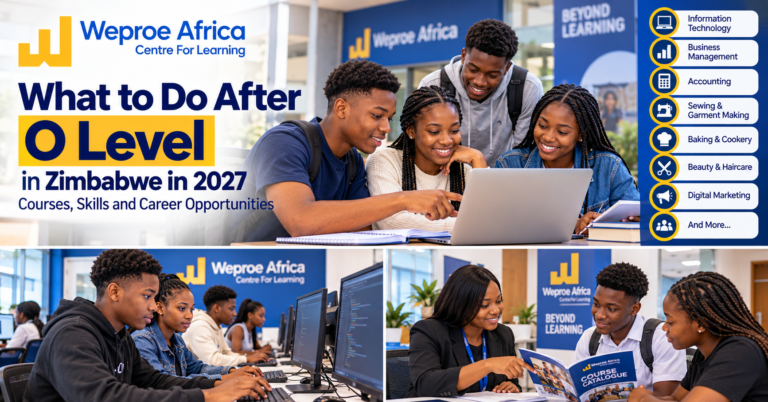
Its published course catalogue includes areas such as:
- Information Technology
- Business Management
- Accounting
- Digital Marketing and Creative Media
- Sewing and Garment Making
- Baking and Cookery
- Beauty and Haircare
Students can explore different certificate and diploma options based on their interests and eligibility.
The institution’s wider educational approach emphasises professional development, skills acquisition and career preparation.
For prospective students, the next step is to compare available programmes and discuss entry requirements, fees, schedules and qualifications with the admissions team.
Explore the WEPROE Africa course catalogue: https://weproe.com/courses
9. A Simple Career Planning Checklist for 2027
If you are completing O Level in 2026, you can begin planning your next steps before your final results are released.
Here is a practical approach.
Step 1: Identify three fields that interest you.
You might choose IT, accounting and business management, or practical fields such as sewing, baking and beauty therapy.
Step 2: Research the available courses.
Look at the course content, duration, location, training approach and qualification.
Step 3: Compare the entry requirements.
Do not register without understanding whether your academic background meets the programme requirements.
Step 4: Discuss the financial requirements.
Speak with your parents, guardians or other financial supporters where applicable.
Step 5: Contact the institution.
Ask specific questions about admissions, fees, learning schedules and assessments.
Step 6: Start developing useful habits.
Improve your communication, organisation, computer literacy and time-management skills.
These abilities can help you across many educational and professional settings.
Frequently Asked Questions About Life After O Level in Zimbabwe
What can I study after O Level in Zimbabwe?
Depending on your results and the entry requirements of each institution, options may include Advanced Level, professional certificate programmes, diplomas, vocational training and apprenticeships.
Can I study a professional course without A Levels?
Some professional and vocational programmes accept applicants without A Levels.
However, entry conditions vary. Contact the training institution to confirm the requirements for your chosen course.
Does WEPROE Africa offer courses for students after O Level?
WEPROE Africa’s website includes an O Level Entry course category, alongside other course categories.
Prospective students should confirm their eligibility for individual programmes before applying.
Are short courses worth studying?
Short courses may be useful for exploring a field, developing introductory skills or building on existing knowledge.
Their value depends on the quality of the training, the relevance of the curriculum and your intended use of the skills.
Can I start a small business after learning a practical skill?
Practical skills can support entrepreneurship, but running a business also requires resources, planning, market research, customer service and, where applicable, regulatory compliance.
How long are WEPROE Africa courses?
Course durations vary. Its published catalogue includes selected one-month practical certificates, longer professional certificates and 12-month diploma programmes.
Check the current listing for the specific course you want to study.
Final Thoughts: Your Future Does Not Have to Follow One Path
Completing O Level is an important step, but it does not determine every opportunity available to you.
There are different ways to continue learning and developing professionally.
Some students will choose Advanced Level and university studies. Others may pursue professional qualifications, practical training or apprenticeships.
What matters most is choosing a pathway that fits your circumstances, interests and future ambitions.
Take time to research. Ask questions. Compare your options.
Most importantly, continue developing your abilities.
At WEPROE Africa, we believe education should help learners develop knowledge and practical skills they can apply beyond the classroom.
Start Planning Your 2027 Learning Journey
Are you exploring courses after O Level in Zimbabwe?
Discover the professional and practical training programmes available at WEPROE Africa Centre for Learning.
Visit: https://weproe.com/courses
Call or WhatsApp: +263 78 118 1302
Location: 3 Nirvana Road, Hatfield, Harare, Zimbabwe
WEPROE AFRICA — Beyond Learning.